The American Consumer's Report Card: Are We Shopping or Just Surviving?
Written by Arbitrage • 2026-11-17 00:00:00
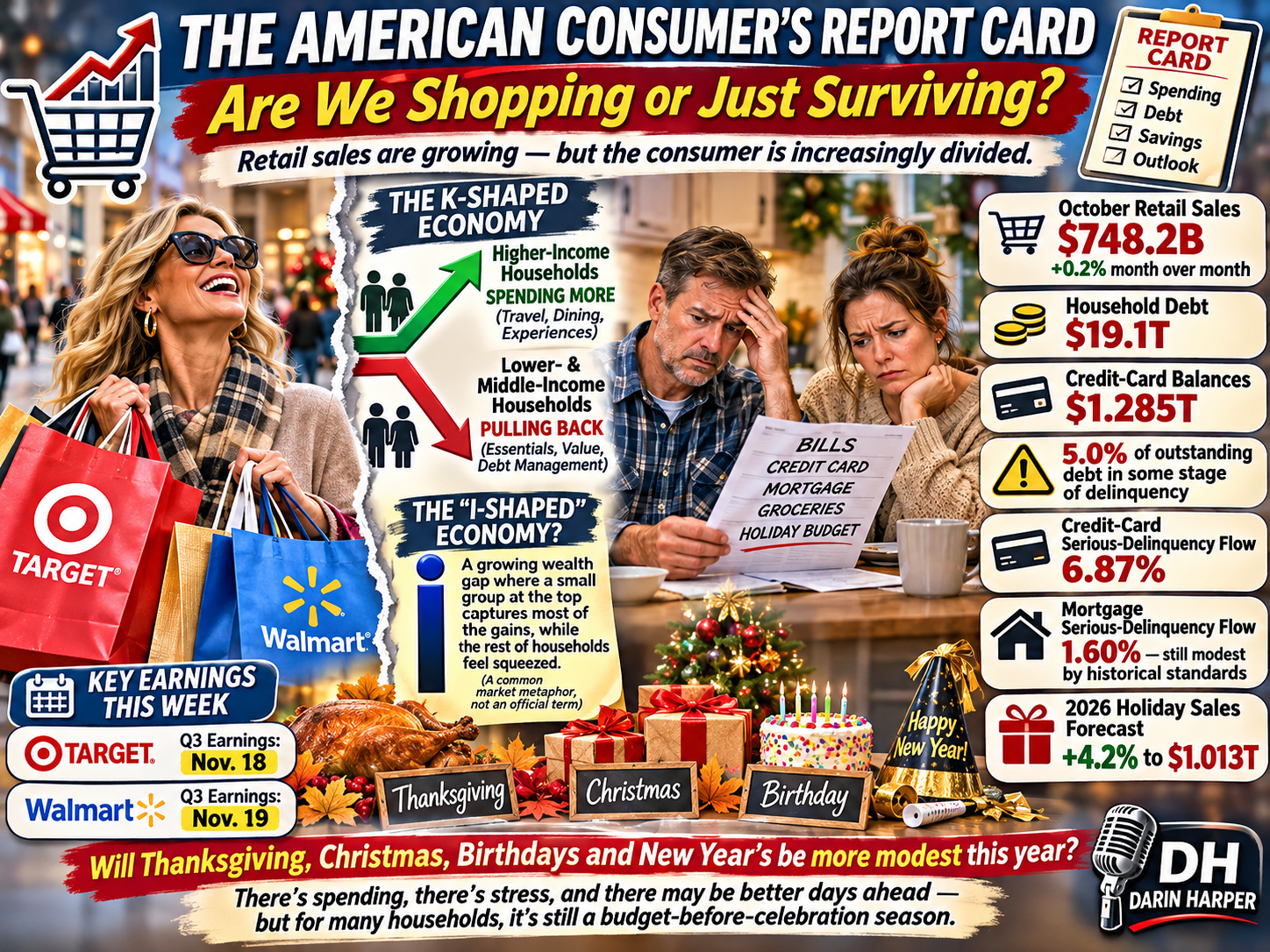
If the American consumer were bringing home a report card this week, the teacher's note might read: Still spending, but please see me after class. The Census Bureau reported today, November 17, that October retail and food-service sales reached $748.2 billion, up just 0.2% from September but 6.8% from a year earlier. Strip out autos and gasoline and sales were firmer, while a closely watched core measure rose 0.6%. The catch is that consumer prices increased 0.4% in October, meaning headline retail sales did not even keep pace with that month's inflation rate. Target reports third-quarter results tomorrow, November 18, and Walmart follows on November 19, giving us two enormous windows into whether Americans are confidently shopping or simply stretching every dollar until it squeaks. Their previous quarters were strong: Target's net sales rose 5.3% and comparable sales 3.8%, while Walmart's revenue increased 5.9% and Walmart U.S. comparable sales rose 2.6%. Strong retailers, however, do not automatically mean financially comfortable households.
That is where the increasingly familiar K-shaped economy comes in. One branch points upward toward households that own stocks, homes, businesses and other appreciating assets; the other points toward households whose budgets are dominated by groceries, rent, insurance, utilities and debt payments. Federal Reserve research illustrates just how concentrated the cushion has become: the wealthiest 10% of households hold roughly 75% of aggregate wealth, while the top 10% of luxury spenders account for about half of spending on categories such as restaurants, vacations, travel and new vehicles. Some commentators have gone a step further and called the economy I-shaped, a nonstandard but useful metaphor in which the tiny dot at the top represents a relatively small affluent group enjoying most of the financial upside while the long line underneath represents everyone else running much closer to the edge. Whether you prefer K or I, the point is the same: the average consumer is becoming less useful because two households shopping in the same Walmart can be living in completely different economies.
Debt is where that divide becomes harder to laugh about. The New York Fed says total household debt reached a record $19.1 trillion in the third quarter, including $13.4 trillion in mortgages and $1.285 trillion in credit-card balances. Five percent of outstanding household debt was in some stage of delinquency, up from 4.7% the prior quarter. Credit cards deserve some nuance because different delinquency measures tell different stories. Earlier this year, the share of credit-card balances already 90 or more days delinquent had climbed to 12.8%, a level the New York Fed said prompted comparisons with rates not seen since the Great Recession. But the current flow of balances newly entering serious delinquency actually improved slightly: 6.87% in Q3 versus 7.05% a year earlier. Mortgages are moving in the opposite direction, with the flow into serious delinquency rising to 1.60% from 1.28% a year earlier, but the New York Fed specifically says mortgage serious delinquency remains modest by historical standards. So no, we are not looking at a 2008-style mortgage crisis. Credit-card stress, though, is elevated enough that it should not be dismissed just because the shopping mall parking lot is full.
The household budget explains why people can keep spending while simultaneously feeling miserable about the economy. Personal consumption spending rose 0.5% in September while personal income increased only 0.2%, and the saving rate fell to 3.8%. Real disposable income actually declined 0.3% that month. October did not deliver much relief: average hourly wages rose 0.4%, but consumer prices also rose 0.4%, leaving real hourly earnings unchanged. That is the economic version of running on a treadmill - you are moving, you are sweating, and somehow you are still standing in exactly the same place. Consumer sentiment has improved slightly, with the University of Michigan's preliminary November index rising from 48.0 to 51.0, but 51 is hardly the sound of America collectively shouting, "Put it on my card!" The consumer is functioning. That is different from flourishing.
Does that mean Thanksgiving, Christmas, birthdays and New Year's Eve are headed for the economic witness-protection program? Probably not across the board. The National Retail Federation still expects November and December holiday sales to rise 4.2% to a record $1.013 trillion, while Deloitte's survey has households planning to spend an average of $1,654, up 4% from last year. But underneath those impressive numbers is a much more cautious consumer: 38% of Deloitte respondents qualify as aggressive value seekers and planned spending on holiday activities is expected to decline 4%. Deloitte's holiday-travel survey released today is even more revealing: only 47% of Americans plan to travel over the holidays, down seven percentage points from last year and the lowest level in recent post-pandemic surveys. Even households earning $200,000 or more are pulling back on paid-lodging vacations. There is no comparable national forecast for every birthday party or New Year's gathering, but it is reasonable to expect the same behavior - people will still celebrate, but more will compare prices, hunt promotions, travel less, eat at home and quietly suggest that this year's birthday gift is "the gift of quality time."
There are signs that better days could be ahead, but soon depends heavily on which household you ask. The economy grew at a strong 3.4% annual rate in the third quarter, employers added 165,000 jobs in October and unemployment remains relatively low at 4.1%. Retail spending is still growing, consumer sentiment has bounced off October's low, and neither credit-card nor mortgage data currently suggest a broad financial collapse. On the other hand, the Fed says inflation remains elevated, the policy rate is still 3.75% to 4.00%, September PCE inflation was 3.6%, real wages went nowhere in October and household savings remain thin. The most hopeful scenario is not a consumer suddenly going on another spending spree; it is inflation cooling enough for wages to begin winning again, interest costs eventually easing, and households rebuilding savings instead of using credit to bridge the gap between payday and real life. Until then, the American consumer's grade is probably a B for effort, a C for financial comfort, and an A-plus for somehow keeping Thanksgiving, Christmas, birthdays and New Year's on the calendar anyway.