What the 30-Year Has to Do With the Yen Intervention - Part 1
Written by Arbitrage • 2026-08-11 00:00:00
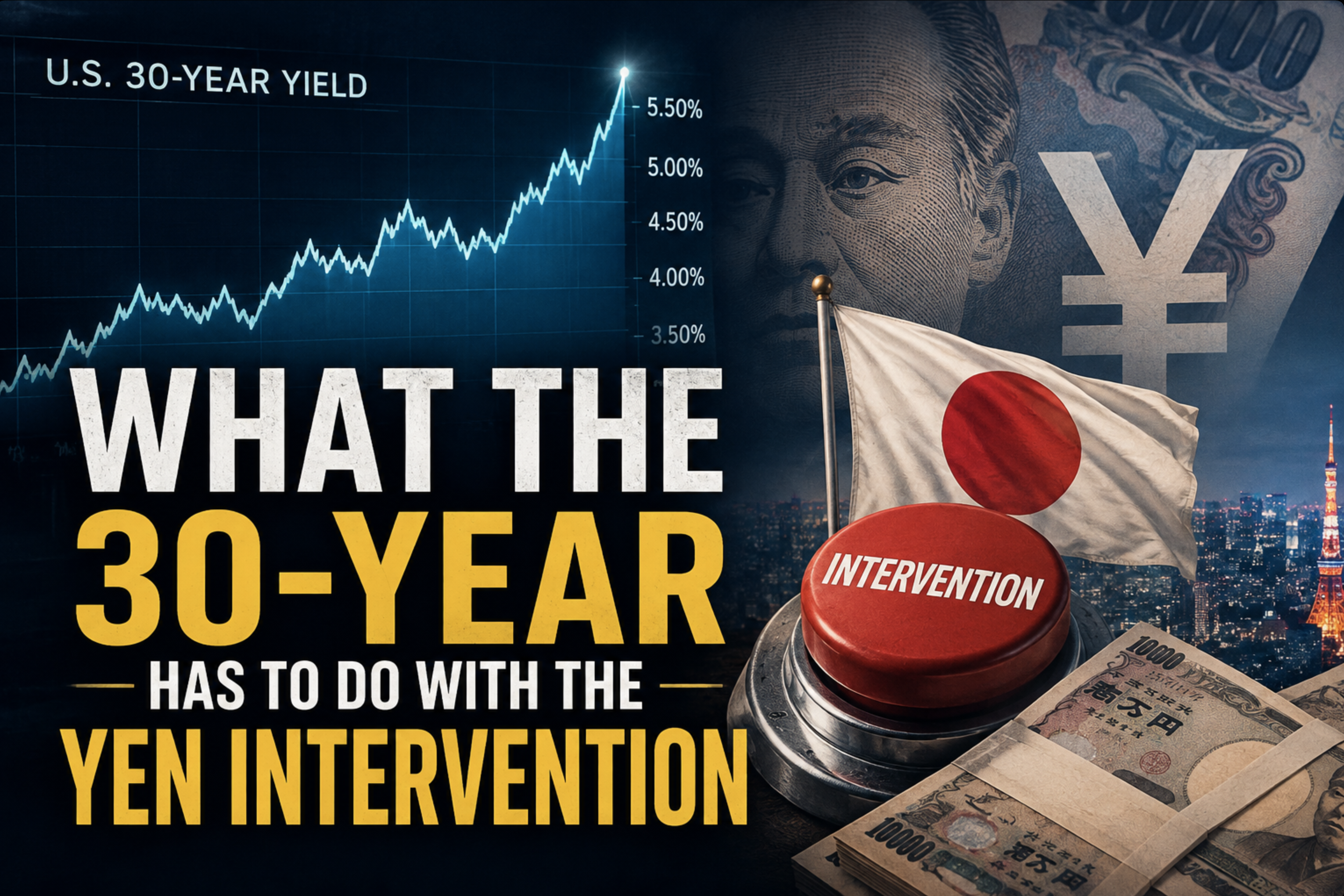
Last week handed us two numbers worth putting side by side. On Thursday, the yen traded at 163.73 to the dollar, its weakest level since 1986. The day before, the 30-year Treasury yield touched 5.244%, a level it hadn't seen since July 2007. Most of the coverage treated these as separate files. One is a currency problem for Tokyo, driven by rate differentials and a heavy fiscal program. The other is a duration problem for Washington, driven by supply, sticky inflation and a Fed that's holding while a minority of its committee wants to hike. Read the sequence of events that followed, though, and it becomes harder to keep the two files apart. The yen defense and the US long end look like one problem with two prices attached.
What actually happened
On Friday the US Treasury bought yen. The Federal Reserve Bank of New York sold euros for yen on the Treasury's behalf, with the trades executed through Goldman Sachs and Morgan Stanley. Earlier in the session, the Treasury had told a number of banks to be ready for possible action, and a Reuters photographer captured a note on Treasury Secretary Scott Bessent's pad at Camp David listing a yen purchase of five to ten billion dollars.
It followed apparent Japanese action on Thursday. Bank of Japan figures pointed to Japanese selling of as much as 58.97 billion dollars to buy yen, which would rank among the larger single operations Tokyo has run.
On Monday, Japan's finance ministry confirmed the two operations were coordinated. It framed the move as a response to what it described as excessive volatility and disorderly movements in the currency, and said it was carried out under the joint statement issued by the Japanese and US finance ministers in September 2025. Both sides indicated they're prepared to act again. President Trump characterized US participation as a gesture of support for Japan and for global economic stability.
Why this is out of the ordinary
Coordinated yen buying by Washington and Tokyo is rare enough that the precedents are countable. The last joint operation of this kind was in 1998. The last time the US Treasury directly supported the yen at all was 2011, as part of a G7 response after the earthquake and tsunami.
The posture shift is what invites a second look. As recently as January, Bessent dismissed speculation about US intervention in the yen and restated a strong dollar policy, arguing that sound fundamentals ought to pull capital in on their own. Six months later, the New York Fed is selling euros to buy yen. Something in the calculation changed, and the stated trade rationale, that a weak yen widens the US deficit and flatters Japanese exporters, has been true throughout the period. It doesn't explain the timing on its own.
How a currency defense reaches the US long end
The mechanics are worth spelling out, because this is where the two stories join up. When a country defends its currency alone, it has to fund the operation. Japan sells dollars and buys yen, and those dollars come out of reserves. Japan's reserves are, to a large extent, US government paper. As of March 2026, Japan held roughly 1.19 trillion dollars of Treasury securities, making it the largest foreign holder and accounting for something close to 13% of all foreign-held US government debt out of a foreign total near 9.3 trillion dollars.
A defense of modest size can be funded from cash balances and maturing positions without touching the market. A sustained defense at scale is a different proposition. It starts to imply outright sales, and outright sales imply supply arriving in a market where the long end has already been repricing. The 10-year is up around 57 basis points since the start of the year. The 30-year jumped 10.5 basis points to close at 5.201% on the day the Federal Open Market Committee left rates at 3.50% to 3.75%, with three members dissenting in favor of a quarter-point hike.
That's the context in which Washington showed up. Reporting on the intervention has been direct about the motive: the US side wanted to avoid a situation in which Japan defends the yen by itself and pays for it by selling Treasuries, pushing US yields higher in the process. Analysts have also pointed to a second layer, which is that a coordinated operation can buy time for the Bank of Japan until it's in a position to keep normalizing, addressing the differential that's driving the yen weaker rather than only the symptom.
None of this is stated policy, and motive is always an inference. But the pattern is consistent with a reading that portfolio managers should probably take seriously: the US long end now functions as a constraint on the range of policy choices Washington is willing to tolerate elsewhere.
Come back tomorrow for Part 2 of this topic!
Disclaimer: This material is provided by Arbitrage Trade for informational and educational purposes only. It does not constitute investment advice, a recommendation, an offer or a solicitation to buy or sell any security or financial instrument. Any examples are illustrative and describe observed conditions and patterns rather than predictions of future outcomes. Past performance is not indicative of future results. Readers should conduct their own research and consult a licensed professional before making any investment decision.