From $2.7 Billion to $13.9 Trillion: The BlackRock Story - Part 1
Written by Arbitrage • 2026-06-01 00:00:00
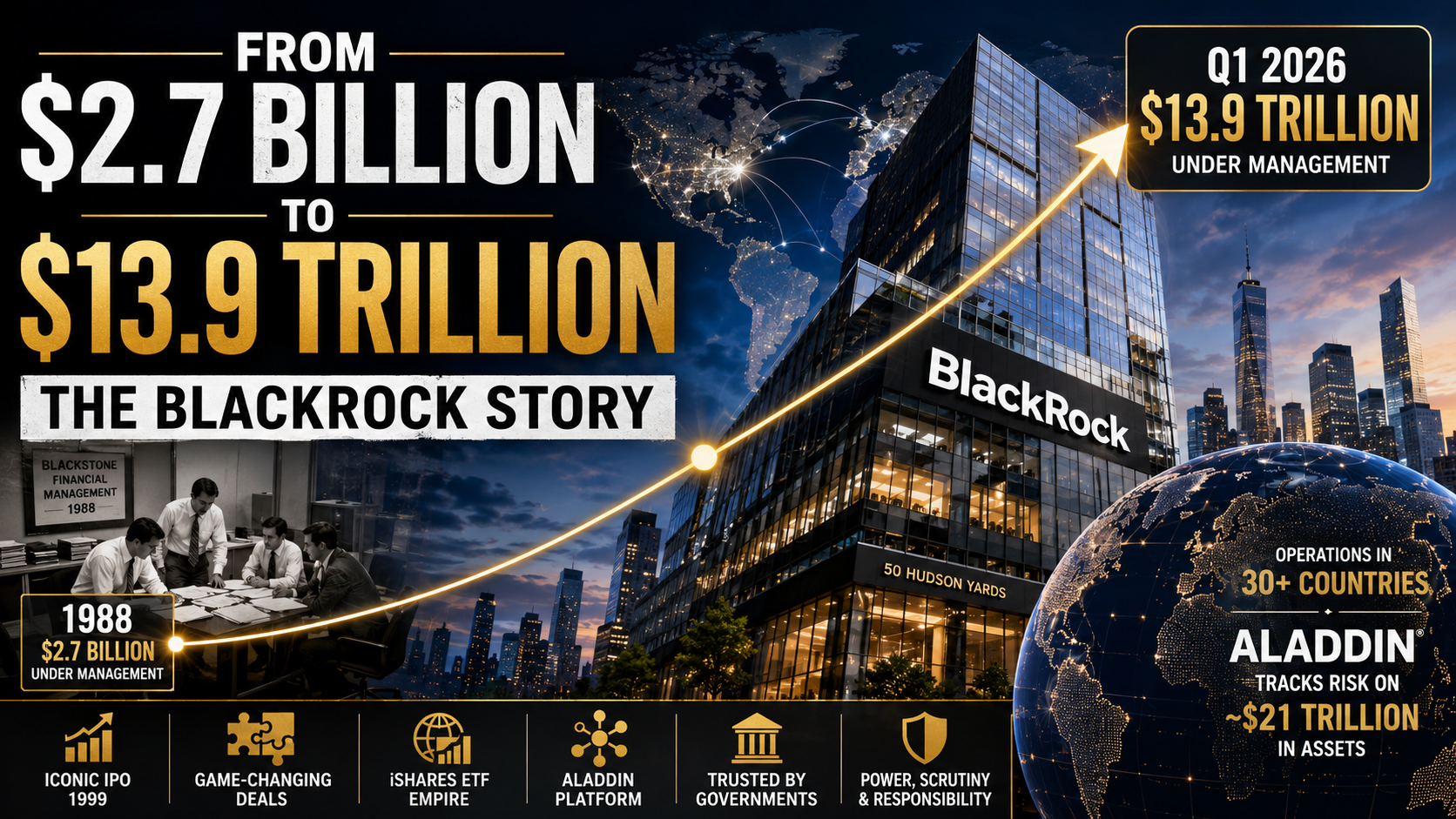
BlackRock manages $13.9 trillion as of the end of the first quarter of 2026. That is larger than the GDP of every country on earth except the United States and China. It's roughly the combined value of every listed company in the UK, France, Germany, and Japan. And it's all run by a firm that didn't exist forty years ago.
In 1988, BlackRock was eight people in a single rented room inside Blackstone, with $2.7 billion under management by the end of their first year. Today it sits at 50 Hudson Yards in New York with roughly 21,000 employees, operations in more than thirty countries, and a software platform called Aladdin that tracks risk on around $21 trillion in assets, much of which BlackRock doesn't even manage.
This is the story of how that happened. The IPO that gave them currency, the 2009 acquisition that doubled them overnight, the ETF empire most retail investors are now invested in without knowing it, the platform business hiding inside the asset manager, and the controversies that come with managing a pool of capital larger than most economies.
The Origin Story: 1988 to 1994
Larry Fink's career nearly ended in 1986. He was 33, running the mortgage department at First Boston, widely seen as a rising star. Then a bad interest rate bet cost the firm around $100 million in a single quarter. He was effectively pushed out. What he took from that experience shaped everything that followed. Fink concluded that even sophisticated traders didn't really understand the risks embedded in their portfolios. The math behind mortgage-backed securities was complex enough that institutions were running massive positions while flying partially blind. The opportunity, in his view, wasn't in better trades. It was in better risk measurement.
In 1988, Fink partnered with Robert Kapito (also from First Boston) and six others to start a fixed-income asset management and risk advisory firm. Their initial backer was Blackstone Group, the private equity firm run by Stephen Schwarzman and Peter Peterson. Blackstone provided a $5 million credit line in exchange for a 50% stake. The new venture operated as Blackstone Financial Management. By the end of their first year, the firm had $2.7 billion under management. By 1991, that number was $9 billion. The growth was driven by a clear pitch: institutional clients didn't just want someone to manage their bonds, they wanted someone to tell them what they actually owned and what could go wrong.
In 1992, the firm split from Blackstone over a dispute about equity dilution and rebranded as BlackRock. The Blackstone connection ended on uncomfortable terms. Two years later, in 1994, PNC Bank acquired BlackRock for $240 million. Schwarzman has since said selling out was the biggest mistake of his career, which is a remarkable admission from the man who later built Blackstone into the world's largest private equity firm. BlackRock was built as a risk management firm first, an asset manager second. That sequencing matters for everything that came later.
The Public Era and the Deal That Changed Everything
Two events between 1999 and 2009 turned BlackRock from a respected bond shop into the largest asset manager on earth.
The 1999 IPO
BlackRock listed on the New York Stock Exchange in October 1999 at $14 a share. AUM at the time was around $165 billion, large by industry standards but not extraordinary. The IPO mattered for a different reason: it gave Fink a public currency. From that point on, BlackRock could grow through acquisition, paying in stock rather than cash. The first big test came in 2006, when BlackRock acquired Merrill Lynch Investment Managers in a deal that nearly doubled AUM to around $1 trillion. Merrill got 49.8% of the combined entity. The deal was significant on its own, but it was a warm-up for what came next.
Barclays Global Investors, 2009
In June 2009, with the financial crisis still smoldering, Barclays needed cash. The UK bank had taken heavy losses and was looking to shore up its balance sheet. BlackRock offered $13.5 billion in cash and stock for Barclays Global Investors (BGI), the bank's asset management arm. BGI brought two things. First, around $1.5 trillion in additional AUM, which when added to BlackRock's existing book made the combined firm the largest asset manager in the world by a wide margin. Second, and more important in retrospect, BGI brought iShares. The iShares franchise was already the largest ETF business globally, but in 2009 the ETF wave was still early. The full economics of that business hadn't been priced in.
Fifteen years later, the BGI acquisition is widely regarded as one of the best deals in modern financial history. Barclays sold under duress and BlackRock walked away with the dominant platform in what became the fastest-growing product category in asset management.
There's a smaller but important sub-thread to this period. In 2008, the US Treasury hired BlackRock to manage the wind-down of toxic assets from Bear Stearns and AIG. This was the first time BlackRock formally played the role of quasi-public utility, hired by the government to manage a crisis using its risk infrastructure. It wouldn't be the last.
Come back tomorrow for Part 2 of this topic!
This article is published for general informational purposes only and reflects patterns observed in publicly available filings, press releases, and reporting. It does not constitute investment advice, a recommendation, or an offer to buy or sell any security. Figures referenced are based on BlackRock's published disclosures as of the relevant reporting dates and are subject to change. Readers should conduct their own analysis or consult a qualified professional before making investment decisions.