The History of Options: From Tulip Fields to Zero-Date Trades - Part 1
Written by Arbitrage • 2026-07-20 00:00:00
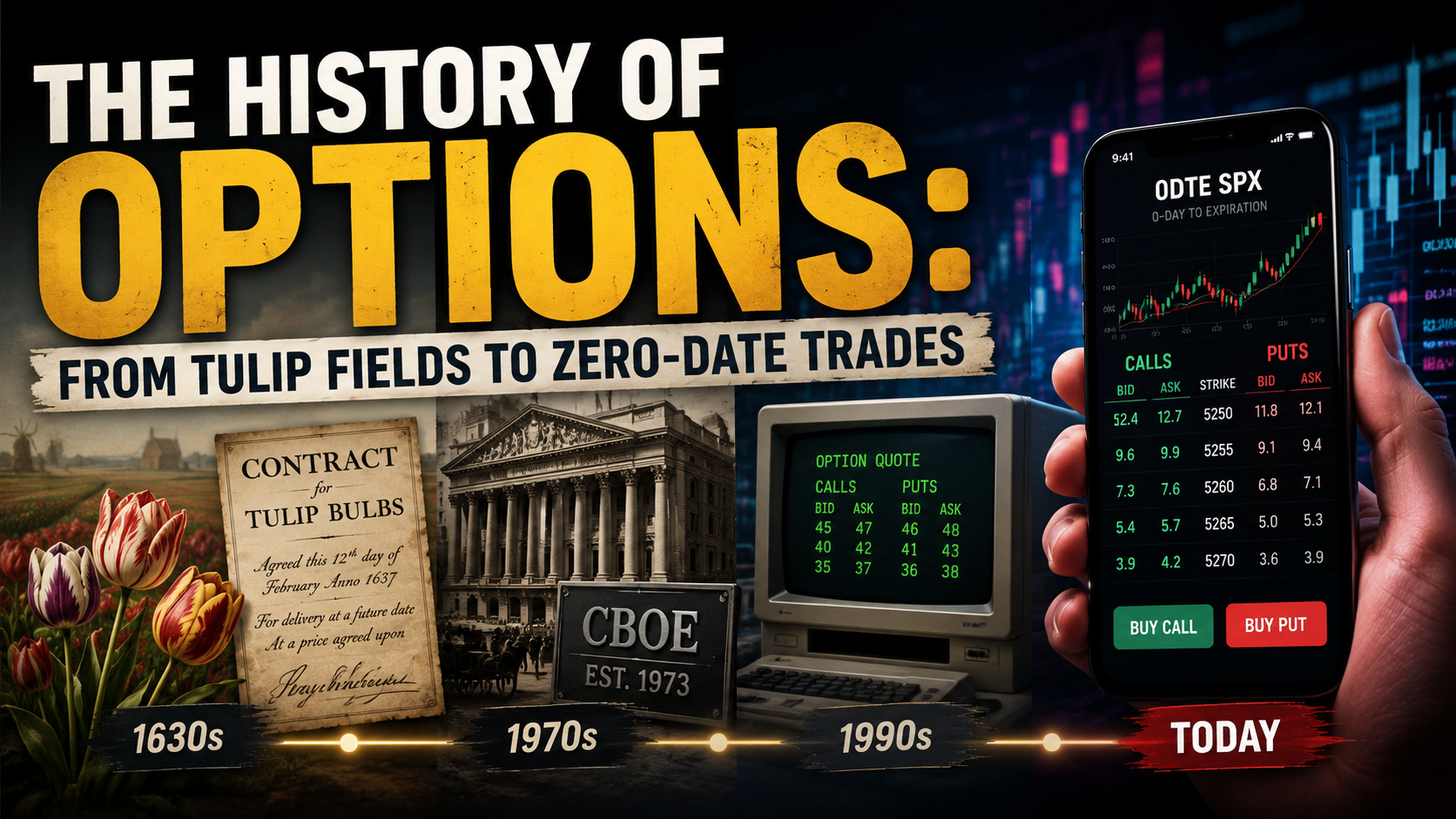
Introduction: A Contract Older Than the Stock Market Options feel like a distinctly modern instrument. They live on fast screens, they get quoted in Greeks, and the newest versions expire in a matter of hours. It's easy to assume they were invented alongside the electronic markets that made them famous.
They weren't. The core idea behind an option, paying for the right to do something without the obligation to do it, is one of the oldest financial concepts we have a record of. It predates the stock exchange, the ticker tape, and the calculator. It shows up in ancient Greece, in the tulip fields of the Dutch Golden Age, and in the back rooms of Victorian London long before anyone could agree on what a fair price for one should be.
This is the story of how that idea traveled from olive presses to same-day expiries, and why the arc matters for anyone watching today's market. Because once you see where options came from, the conditions and patterns driving the current market start to look less like a modern anomaly and more like the latest chapter in a very long book.
Ancient Roots: The First Recorded Option
The earliest option story we have comes from Thales of Miletus, a Greek philosopher and mathematician living around 600 BC. As Aristotle later told it, Thales was tired of being mocked for his poverty, so he put his skills to work. Reading the weather and the stars, he formed a view that the coming olive harvest would be a strong one. Rather than buy olive presses outright, which would have been expensive and risky, he paid the local press owners a small fee for the right to use their presses at harvest time. He wasn't obligated to use them. He'd simply secured first claim if he wanted it. When the harvest came in strong and demand for presses spiked, Thales controlled access to them and profited handsomely.
Strip away the ancient setting and you have a textbook call option. Thales paid a premium for the right, not the obligation, to acquire something at a set price in the future. The concept of buying optionality was alive and working thousands of years before a formal exchange existed to trade it.
Tulip Mania and the Dutch Golden Age
Fast forward to the 1630s and Amsterdam, then the beating heart of global commerce. The Dutch had built sophisticated markets, and one of the more colorful obsessions of the era was the tulip. Rare bulbs traded at extraordinary prices, and around that speculative frenzy, a market in options-style contracts took shape.
The mechanics were surprisingly familiar. Growers who worried about falling prices could buy the right to sell their bulbs at a set price, which functioned like a put. Buyers who wanted exposure to rising prices without committing the full capital could pay for the right to buy at a fixed price, which functioned like a call. In both cases, a modest premium bought a claim on a future outcome, and both sides used these contracts to manage the uncertainty of a market where bulb prices could swing wildly between planting and harvest. Then came 1637. The tulip market collapsed, fortunes evaporated, and the episode became one of history's favorite cautionary tales about speculation. Options caught part of the blame, and the association between optionality and reckless gambling lingered for centuries afterward.
There's a thread worth pulling here, because it runs through the entire history of the instrument. An option is a tool for managing uncertainty. It's also a vehicle for speculation. The same contract can serve either purpose, and which role it plays depends far more on how it's used than on anything inherent in the structure itself. That tension shows up again and again, right through to the modern era.
Come back tomorrow for Part 2 of this topic!
This content is for educational and informational purposes only and does not constitute financial, investment, or trading advice. It is not a recommendation to buy, sell, or hold any security or to pursue any particular strategy. All examples are illustrative. Trading and investing involve risk, including the possible loss of capital. Past patterns and conditions do not guarantee future results. Always conduct your own research and consult a licensed professional before making any financial decisions.