The History of Options: From Tulip Fields to Zero-Date Trades - Part 2
Written by Arbitrage • 2026-07-21 00:00:00
If you have not read yesterday's blog post, please do so before continuing here.
The Long, Messy Middle: Options Before Standardization
For the next few centuries, options existed in a kind of legal and financial gray zone. In seventeenth and eighteenth century London, "put and call" dealers made markets in these contracts, though the trade carried a shady reputation and drifted in and out of legality.
Across the Atlantic, nineteenth century America developed its own over-the-counter options scene. Figures like Russell Sage became known for dealing in puts and calls, building contracts to order for anyone who wanted them. But the whole enterprise ran on a foundation of sand. There was no standardization, so every contract was a one-off negotiation. Spreads were wide. Counterparty risk was real, since a contract was only as good as the person on the other side of it. And perhaps most limiting of all, there was no reliable, shared method for pricing a contract in the first place.
Think about what that last point meant in practice. If two people couldn't agree on what an option was worth, using anything better than gut feel and haggling, the market could never scale. Buyers feared overpaying, sellers feared underpricing risk, and the whole thing stayed a niche, distrusted corner of finance. For all its ancient pedigree, the option remained a fringe instrument well into the twentieth century.
1973: The Year Everything Changed
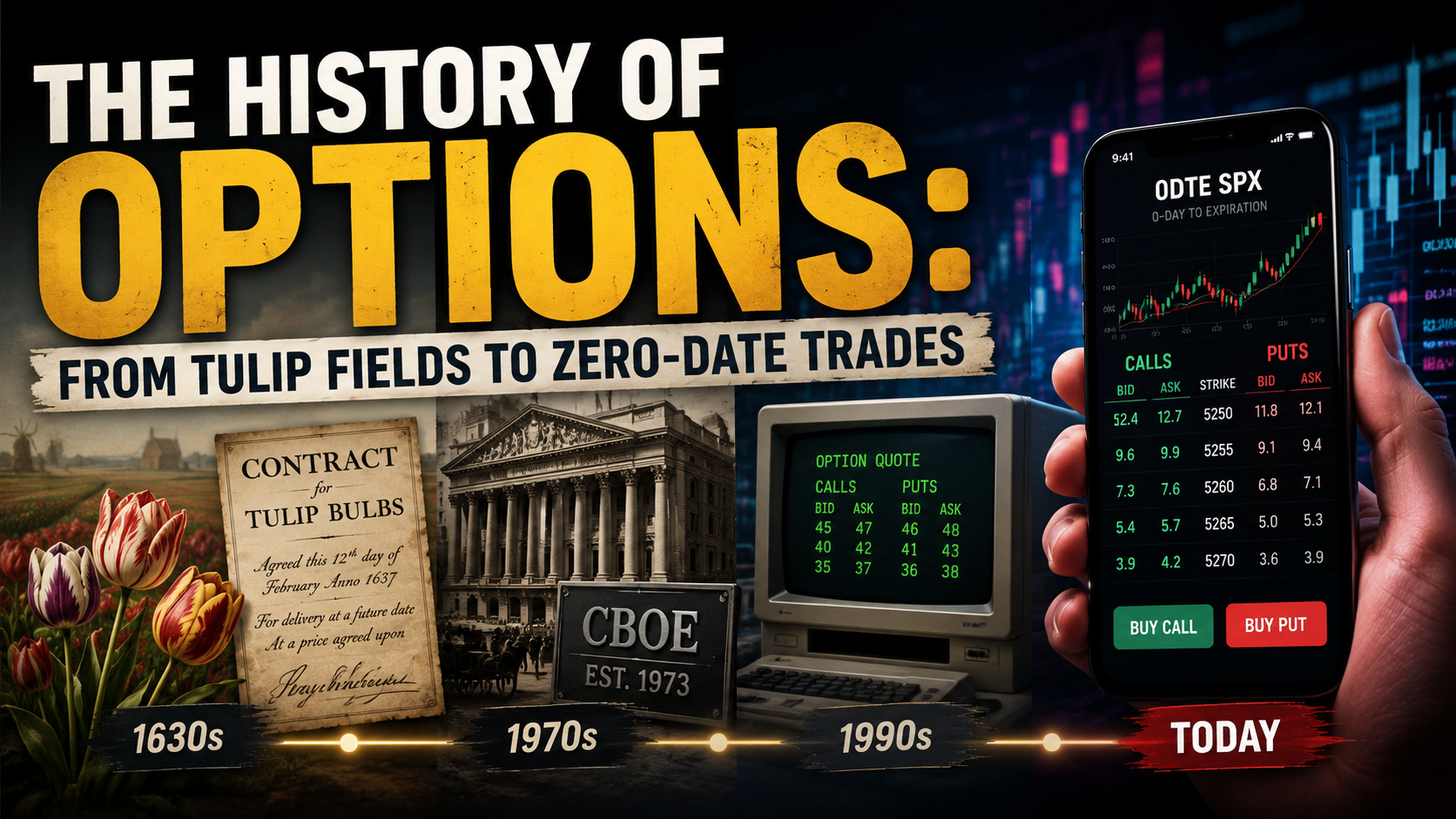
Two things happened in 1973 that, together, transformed options from a backwater into market infrastructure. The first was the launch of the Chicago Board Options Exchange, the CBOE. For the first time, options became standardized, listed, and exchange-traded. Contracts now had uniform terms. A clearinghouse stood behind trades, which took the counterparty risk that had haunted the over-the-counter market and largely neutralized it. Suddenly there was a real, liquid, transparent venue where options could change hands. The second was the publication of the Black-Scholes model. A venue solved the where of options trading. Black-Scholes went after the how much. It offered a shared mathematical framework for pricing an option, and that changed everything, because the market finally had a common language for value.
Neither piece would have been as powerful alone. An exchange without a pricing model would still have left traders guessing. A pricing model without an exchange would have been an elegant idea with nowhere to live. Arriving in the same year, they reinforced each other. The place to trade and the way to price combined to turn a centuries-old fringe instrument into something the modern financial system could build on.
Breaking Down Black-Scholes (Without the Headache)
You don't need the equation to understand what Black-Scholes accomplished. The model set out to answer a deceptively hard question: what is a fair value for an option, given the conditions around it? It answered that by focusing on a handful of inputs. The price of the underlying asset. The strike price of the option. The time left until expiry. Prevailing interest rates. And volatility, the measure of how much the underlying tends to move. Feed those in, and the model produces a theoretical price.
The conceptual breakthrough wasn't the arithmetic. It was the insight underneath it. Black-Scholes reframed option pricing around the idea of replicating risk rather than guessing direction. Instead of asking "will this stock go up," it asked "what combination of the underlying asset and borrowing would replicate this option's payoff," and priced the option off that. Direction, the thing most traders obsess over, moved to the background. Volatility and time moved to the front. The work is credited to Fischer Black, Myron Scholes, and Robert Merton, whose related contributions were central to the framework. Scholes and Merton received the Nobel Memorial Prize in Economic Sciences in 1997. Black had passed away in 1995 and so wasn't eligible, though his name remains on the model.
One grounded caveat belongs here, because it matters for how the model gets used. Black-Scholes rests on a set of assumptions, including things like constant volatility and smooth, continuous price movement, that real markets don't always match. Markets gap. Volatility shifts. Tails turn out fatter than the model expects. None of this makes the framework useless, and it remains a foundation of how options are priced and understood. But treating any model as a perfect description of reality, rather than a useful approximation of it, is a pattern that tends to end badly. The map is not the territory.
Come back tomorrow for Part 3 of this topic!
This content is for educational and informational purposes only and does not constitute financial, investment, or trading advice. It is not a recommendation to buy, sell, or hold any security or to pursue any particular strategy. All examples are illustrative. Trading and investing involve risk, including the possible loss of capital. Past patterns and conditions do not guarantee future results. Always conduct your own research and consult a licensed professional before making any financial decisions.