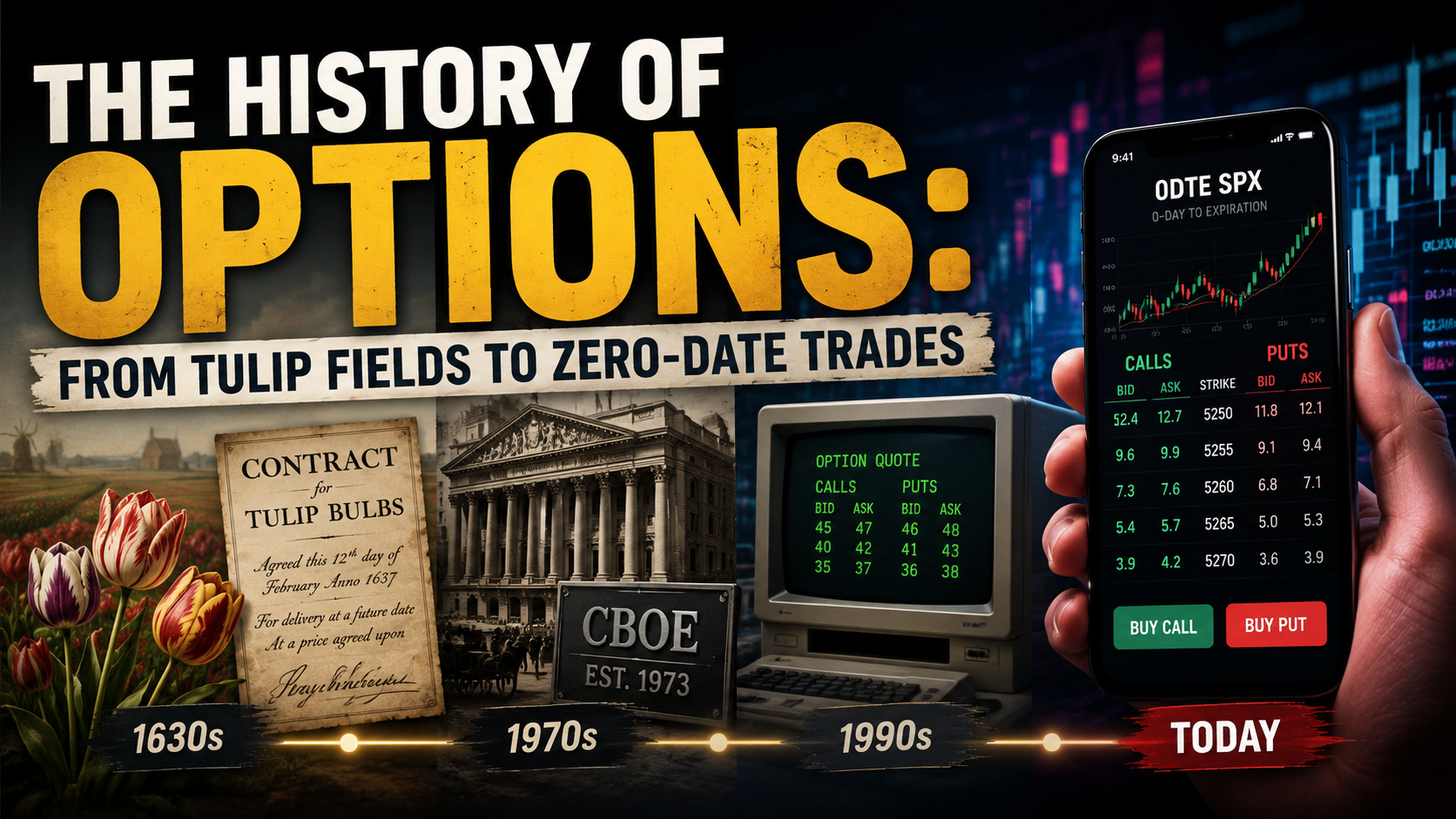
The History of Options: From Tulip Fields to Zero-Date Trades - Part 3
Written by Arbitrage • 2026-07-22 00:00:00
If you have not read Part 1 and Part 2 of this topic yet, please do so before continuing here.
The Modern Build-Out: Volatility, the Greeks, and the VIX
Once options were standardized and priceable, the market around them grew fast, and it grew data-rich. Listed contracts generated a steady stream of information about how participants were positioned and how they viewed risk. Out of that came the working language of options risk, the Greeks. At a conceptual level, delta describes how much an option's price tends to move relative to the underlying. Gamma describes how quickly that sensitivity itself changes. Theta captures the effect of time passing, the slow bleed of an option's value as expiry approaches. Vega captures sensitivity to changes in volatility. Traders use these as the vocabulary for measuring and managing exposure, rather than eyeballing a position and hoping.
Then came a genuinely novel step: making volatility itself something you could track and trade. The VIX, introduced in the early 1990s and later revised, distilled expected volatility from options prices into a single number. That opened the door to treating volatility as its own asset, not merely an input to pricing something else. The instrument that started as a claim on olive presses had become abstract enough that people were now trading the market's expectation of its own future movement. The expansion kept going. Index options let participants take positions on whole baskets rather than single names. LEAPS stretched expiries out for years. Step by step, the universe of what could be optioned, and the ways it could be sliced, kept widening.
The Compression Era: Weeklys to Zero-Date Options
If the long arc of options history has a recent theme, it's compression. The time horizon of the contracts kept shrinking. For decades, most options expired monthly. Then the CBOE introduced weekly SPX options in 2005, expiring on Fridays. In 2016 it added Wednesday expiries. And in 2022 it expanded to offer SPX options expiring on every trading day. That final step is what created the modern zero-date, or 0DTE, phenomenon. The term is simpler than it sounds. Zero days to expiration means a contract that expires at the end of the current trading day. Technically, every option becomes a 0DTE option on its own expiry date. What changed in 2022 is that traders could now open fresh same-day contracts every single session, not just on the occasional monthly or weekly expiry.
Several conditions fueled the boom that followed. Retail access widened dramatically, with major brokers rolling out index options to their full customer bases. Commissions fell toward zero. Mobile platforms put same-day contracts a few taps away. And the daily SPX expiry schedule meant there was always a fresh, rapidly decaying contract available to trade. Capital efficiency added to the pull, since defined-risk same-day spreads can be entered for relatively modest margin, and the contracts carry no overnight exposure.
The scale is no longer a niche story. As of early 2026, 0DTE contracts have grown to represent a majority of SPX options volume. CBOE data showed 0DTE accounting for well over half of all SPX trading in the opening months of 2026, up from roughly 5% of SPX volume back in 2016. Total US-listed options volume topped 15.2 billion contracts in 2025. This is no longer a corner of the S&P 500 options market. On many days, it is the market.
It's worth looking at the patterns observers point to here, in balanced terms, because this is where the conversation tends to get loud. A meaningful share of 0DTE activity concentrates into specific strikes and specific hours, which creates intraday clusters of trading. There's also the gamma dynamic. When dealers are on one side of heavy same-day positioning, their hedging can move in the same direction as the market, which some argue can amplify intraday swings under certain conditions. Others counter that gross volume is not the same as net dealer exposure, and that much of the flow is balanced enough to leave dealers close to neutral. The honest read is that these are conditions worth watching rather than settled conclusions. What's harder to dispute is that concentrating so much convexity into a single trading day has changed how intraday volatility tends to behave, even on days when the headline volatility number looks calm.
Conclusion: Four Thousand Years of the Same Idea
Trace the line from Thales to today and the instrument looks almost unrecognizable at each end. On one side, a philosopher paying for first claim on olive presses. On the other, millions of contracts a day expiring within hours, hedged by algorithms measuring convexity in real time. But the idea underneath hasn't changed at all. An option has always been about the same thing: paying for the right, not the obligation, and using that right to manage or express a view on an uncertain future. The olive press, the tulip bulb, the standardized SPX contract, they're all variations on that single concept. What's evolved is the packaging, the pricing, and above all the speed.
The throughline is uncertainty. Options exist because the future is unknown, and because there's value in being able to shape your exposure to it without committing fully. That was true in 600 BC and it's true on a 0DTE expiry today.
The compression trend frames the conditions traders are watching now. Horizons have shrunk from months to a single session, positioning can reset within hours rather than weeks, and the intraday gamma state has become part of the terrain of the market itself. Where the arc goes next, whether daily expiries spread further into single stocks and other corners of the market, is the open question. But if four thousand years of history offer any guide, the appetite for optionality isn't going anywhere. Only the clock keeps getting faster.
This content is for educational and informational purposes only and does not constitute financial, investment, or trading advice. It is not a recommendation to buy, sell, or hold any security or to pursue any particular strategy. All examples are illustrative. Trading and investing involve risk, including the possible loss of capital. Past patterns and conditions do not guarantee future results. Always conduct your own research and consult a licensed professional before making any financial decisions.