The Most Important Firm You’ve Never Heard Of - Part 2
Written by Arbitrage • 2026-05-12 00:00:00
If you have not yet read yesterday's blog post, please do so before continuing here.
The Culture That Built the Machine
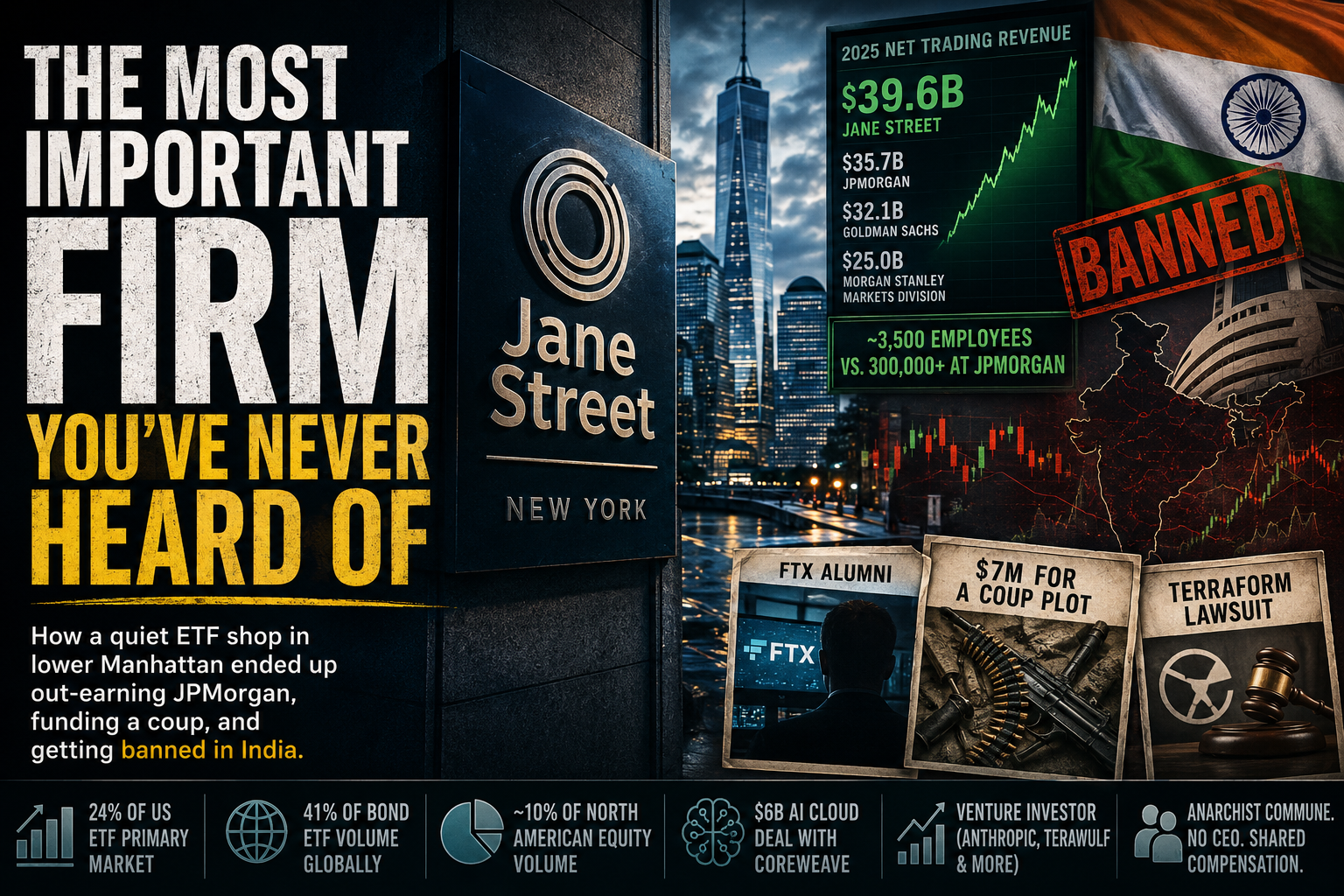
Jane Street's comp pool in 2025 was $9.38 billion. Spread across roughly 3,500 people, that works out to an average of $2.68 million per employee. Comp more than doubled from 2024. To put that number in context, Goldman Sachs averages around $400,000 per head. Citadel Securities, the closest peer in the market making space, brought in $9.7 billion in trading revenue across 2024 (less than a quarter of what Jane Street did in 2025). Virtu Financial brought in $2.9 billion. Flow Traders brought in $500 million. Jane Street is two to forty times larger than its closest competitors.
The compensation structure is part of why Jane Street keeps people. The firm is privately owned and doesn't use non-competes. Instead, employees are paid in a mix of cash and non-publicly-traded equity, with carry from the firm's investments and locked-in stakes in Jane Street's own funds. The lock-ins reportedly continue after employees leave, as long as they don't join a competitor. It's a soft non-compete, designed to make leaving expensive without requiring a contract that bans it.
The cultural code goes deeper than comp. Jane Street has been the largest single feeder firm into the effective altruism movement. The early-2010s pipeline of "earn-to-give" talent at the firm produced both genuine philanthropists and at least one famous casualty. The firm hosts internal book clubs on philosophy and probability theory. It runs a long-running market prediction puzzle competition with prize pools in the six figures. Interviews are weighted heavily towards probability games and quick logical reasoning under pressure.
It is, by most accounts, a strange place. The strangeness appears to be a feature.
The Alumni Diaspora
Jane Street's alumni list is short, but the names on it are unusually consequential.
Sam Bankman-Fried is the most obvious one. He joined Jane Street in 2014, fresh out of MIT, personally recruited by co-founder Robert Granieri. He spent three years there as a junior trader. The Financial Times reported that "having Jane Street on the CV was a crucial bit of Bankman-Fried's sales pitch." He developed a system at Jane Street that called the 2016 US presidential election ahead of major news outlets. He left in 2017 to start Alameda Research, then FTX. The rest of that story doesn't need recounting.
Caroline Ellison, FTX's Alameda chief and the witness whose testimony helped convict Bankman-Fried, was also a Jane Street alum. So was Brett Harrison, who later ran FTX US and now runs Architect Financial Technologies. So was Zvi Mowshowitz, the AI commentator and former magic player. The early FTX leadership team had a Jane Street density that was, in retrospect, hard to ignore.
There is a separate, less famous diaspora into competing firms. The most consequential of those moves involved a small group of Jane Street traders who left for Millennium Management in 2024. Jane Street sued them in US federal court, alleging they had stolen a proprietary trading strategy worth roughly a billion dollars in profits. The strategy, according to court filings, was an arbitrage approach being run in Indian markets. The lawsuit was settled confidentially in December 2024. That courtroom detail (a billion-dollar India strategy described as a trade secret) is what set the next chapter in motion.
The SEBI Saga
On July 3, 2025, the Securities and Exchange Board of India (SEBI) issued an interim order against Jane Street and four affiliates. The regulator alleged the firm had manipulated the Indian equity derivatives market, specifically the Bank Nifty index, between January 2023 and March 2025.
SEBI's preliminary findings described the alleged strategy in two parts. In the morning, Jane Street entities reportedly bought large quantities of Bank Nifty constituent stocks in the cash market, pushing the index higher and signaling a bullish trend to other participants. In the afternoon, those positions were unwound. The reversal was paired with much larger options positions in the derivatives market that profited from the price moves SEBI alleged Jane Street had created. The regulator described the approach as a "pump and dump" operation tailored for high-frequency execution.
The numbers SEBI cited were striking. Jane Street's Indian arm reportedly made roughly $4.3 billion in trading gains in India over a two-year period. Its India entity, JSI Investment Pvt., reported a 494% year-on-year jump in after-tax profit in the financial year ending March 2025, just months before SEBI's order. The regulator ordered Jane Street to deposit 4,843 crore rupees (about $567 million) in alleged unlawful gains into an escrow account and temporarily barred the firm from Indian markets.
Jane Street complied with the deposit. The trading ban was subsequently lifted, though SEBI asked exchanges to closely monitor the firm's positions until investigations conclude. In September 2025, Jane Street appealed to the Securities Appellate Tribunal (SAT), claiming SEBI had denied it adequate access to documents needed to mount a defense and that a separate SEBI inspection had concluded there was no manipulation. The SAT hearing was adjourned in February 2026, and the case remains open.
Jane Street's public defense has been that the strategy was basic index arbitrage and that India's market structure (where options turnover runs at roughly 300 times the underlying equity turnover) is what made the trades so profitable. SEBI's position is that the trades crossed the line from arbitrage into manipulation.
The case is still being adjudicated, and at this stage these are allegations rather than findings of wrongdoing. But the broader question is one regulators in other jurisdictions will eventually have to confront. When a single foreign firm captures a meaningful share of a country's expiry-day options volume, where does liquidity provision end and price-setting begin?
Come back tomorrow for Part 3 of this topic!
*This article is for informational and educational purposes only. It is not investment advice, a recommendation, or a solicitation to buy or sell any security. All allegations referenced in this article remain subject to ongoing legal and regulatory proceedings. Arbitrage Trade has no affiliation with Jane Street Group, LLC or any of its entities.