The Taylor Rule: How a 1993 Formula Still Frames Every Fed Decision - Part 2
Written by Arbitrage • 2026-08-19 00:00:00
If you have not read yesterday's blog post yet, please do so before continuing here.
Descriptive, not prescriptive, and reading the current gap
This is where the rule earns its keep, so it's worth being precise about how the Fed actually treats it.
The Fed does not mechanically follow the Taylor Rule, and it never has. Officials reference Taylor Rule variants in the Monetary Policy Report and in speeches, but as one input among many. The formula can't see forward guidance, financial stability risks, the zero lower bound, or the judgment calls a committee makes when the data send mixed signals. Treat it as a reference line, not a trigger.
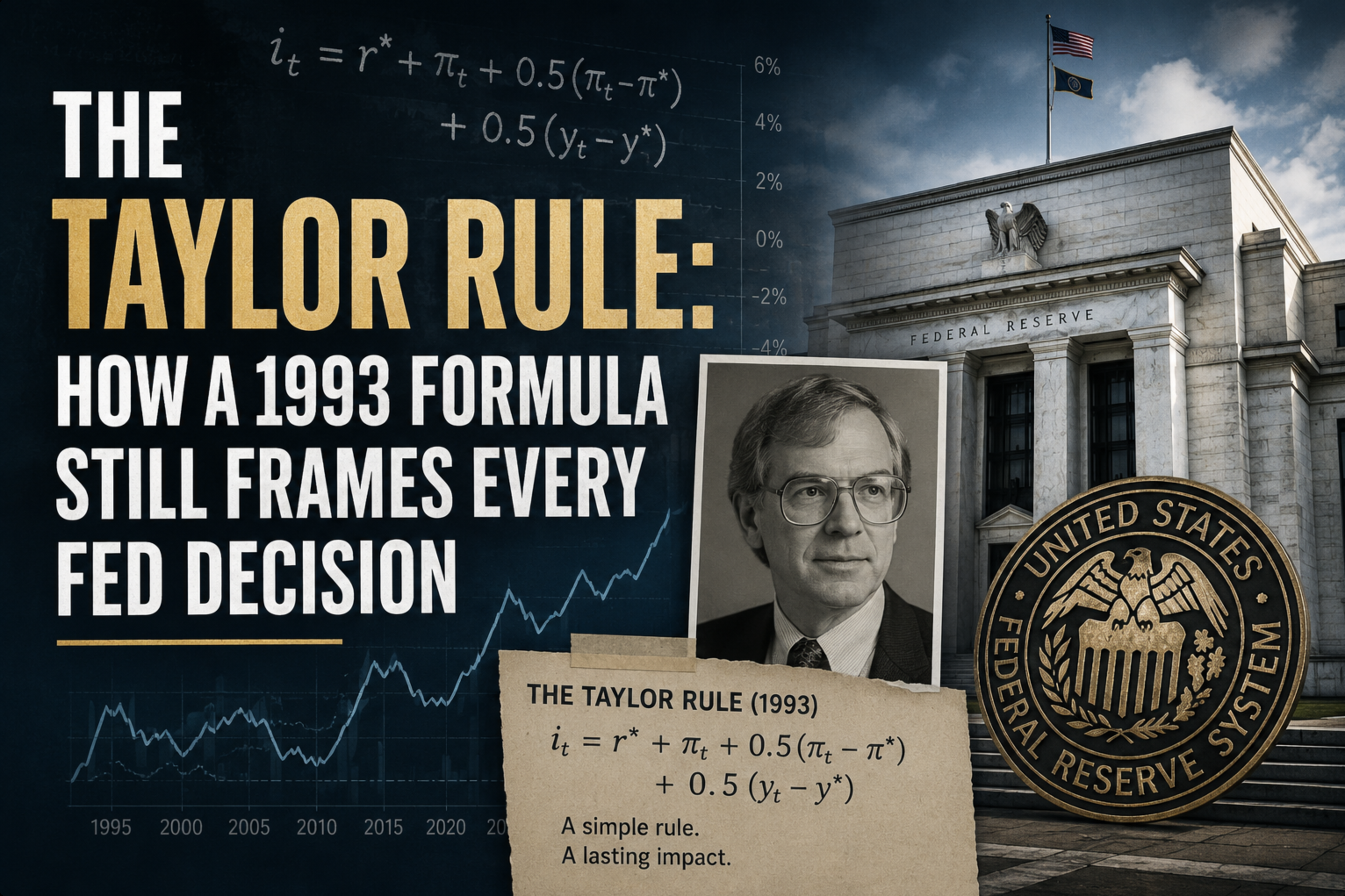
With that framing, here's how to read the current gap. As of mid-2026, the funds rate target range sits at 3.50 to 3.75 percent, a midpoint near 3.6 percent. Core PCE inflation, the Fed's preferred gauge and the default input in most Taylor Rule tools, is running around 3.3 percent, above the 2 percent target. Plug the classic 1993 settings into the formula, with r* at 2 percent and the economy near potential, and the rule points to something close to 6 percent. That sits well above where the funds rate actually is.
Now swap in a lower neutral rate. Use a Laubach-Williams style r* closer to 1 percent, and the prescription falls toward 5 percent. Still above the current rate, but the gap narrows by roughly a point. Same economy, same inflation print, very different reference line, entirely because of one unobservable assumption.
What does the gap tell you? Under either setting, the classic rule points higher than the current funds rate, which is a condition worth noting: relative to the benchmark, policy looks accommodative rather than restrictive, even with inflation still above target. That's a pattern, not a prediction. It's the kind of observation that frames a question, namely why the Fed is comfortable sitting below where the rule points, rather than answering it.
Two practical notes. First, the balanced approach variant, which Taylor introduced in 1999 and which the Fed has referenced, doubles the weight on the output gap, so it reacts more to labor market slack. Second, the Atlanta Fed and the Cleveland Fed both publish live Taylor Rule utilities where you can watch the prescription shift as you change r*, the inflation measure, and the gap. For anyone who wants to see how much the assumptions matter, an hour with one of those tools is worth more than any single number.
A lens, not a lever
Return to the tension we opened with. The Fed insists it doesn't follow a rule, and that's true. So why does a formula from 1993 still frame every rate decision? Because it gives everyone the same starting point for the same question. When a PM, a Fed governor, and a financial journalist all ask whether policy is too tight or too loose, the Taylor Rule is the shared reference they reach for, even when they plug in different assumptions and reach different answers. Its value was never in producing the right number. Its value is in disciplining the conversation, forcing everyone to be explicit about what they assume for r*, for potential, and for how hard the Fed should lean.
So use it the way the professionals do. Not as a lever that tells you what happens next, but as a lens that shows you how far current policy sits from a neutral reference, and what someone has to believe for that distance to make sense. The value is in the gap, not the number.
This material is provided for informational and educational purposes only and reflects observations of market conditions and patterns. It does not constitute investment advice, a recommendation, or an offer or solicitation to buy or sell any security or financial instrument. All examples are illustrative. Past patterns are not indicative of future results. Readers should conduct their own analysis and consult a qualified professional before making any financial decision.