The Token Economy: Why AI's Growth Hinges on the Cost of a Word
Written by Arbitrage • 2026-06-10 00:00:00
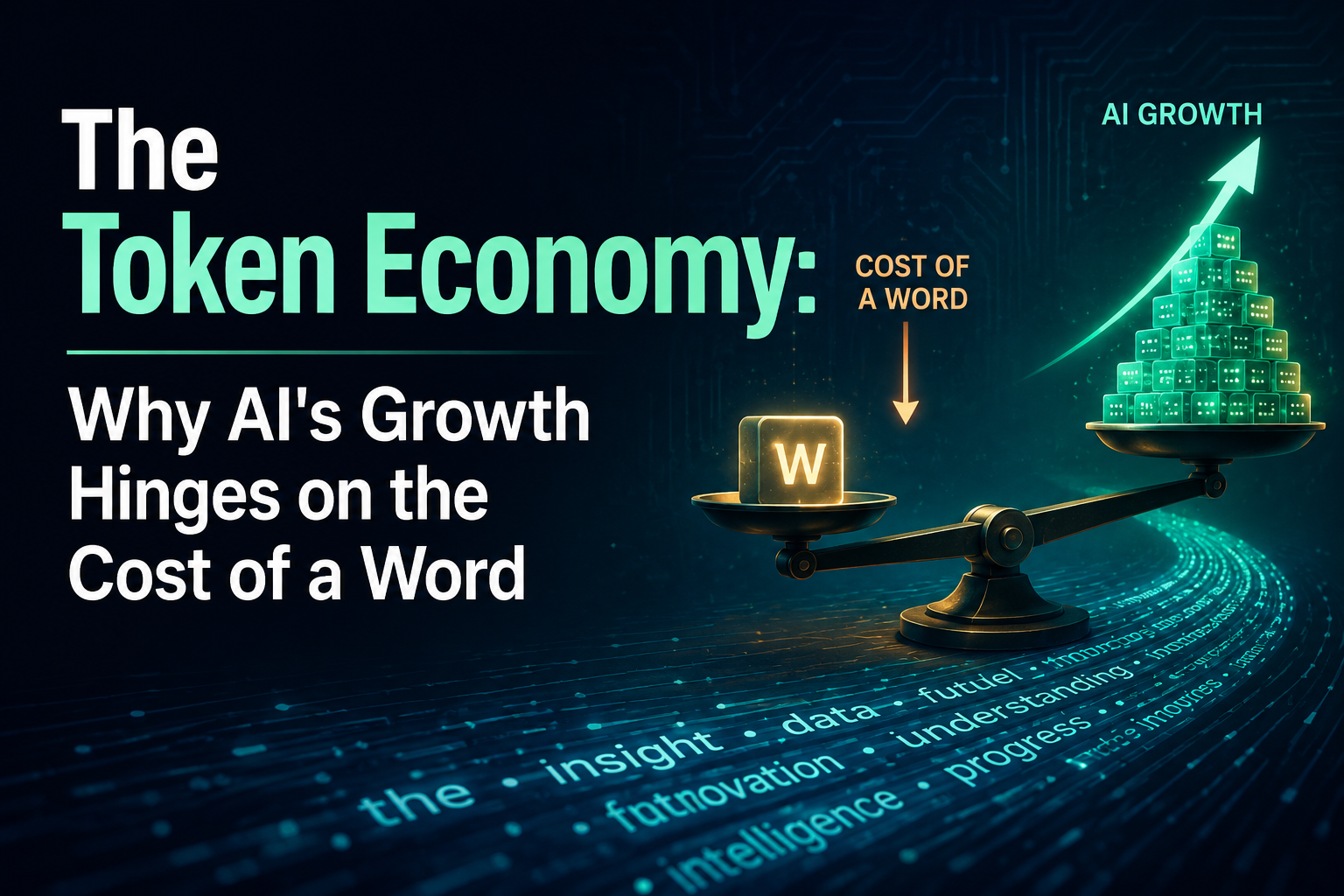
Every time you ask an AI a question, somewhere a meter is running. Not in dollars and cents that you see, but in tokens, the tiny units of text that AI models read and write. A token is roughly a word fragment, a chunk of a few letters. Your prompt gets broken into tokens going in, the answer comes back as tokens going out, and someone, somewhere, pays a fraction of a cent for each one. It sounds trivial, but it isn't. The price of a token is quietly the most important number in artificial intelligence, and the entire industry's future is balanced on top of it.
The unit nobody talks about
Here's the thing about tokens: everything reduces to them. A single chatbot reply, a coding assistant that runs for an hour, an entire company's AI product serving millions of customers. Strip away the marketing and it all comes down to the same equation. Tokens used, multiplied by price per token. That makes the cost of a token the closest thing AI has to a unit of currency. And like any currency, what happens to its value ripples outward into everything built on top of it.
The price has been collapsing
The remarkable part is how fast that value has fallen. Getting the performance of a top-tier 2023 model now costs a tiny fraction of what it did at launch. By one widely cited estimate, the cost to match GPT-4's quality dropped from around $20 per million tokens in late 2022 to roughly $0.40 by the end of 2025, a decline of about 10x every single year. Researchers at Epoch AI found that for some tasks, the price fell even faster, by as much as 40x a year.
To put that in perspective, that's quicker than the cost of computing fell during the personal computer revolution, and faster than bandwidth got cheap during the dotcom boom. A few things are driving it: chips are getting more efficient, models are getting smaller and smarter at the same time, and fierce competition between providers keeps pushing prices down. When the Chinese lab DeepSeek launched models priced far below its rivals, it forced the whole market lower almost overnight.
Why cheap tokens change everything
When something gets dramatically cheaper, people stop rationing it and start lavishing it everywhere. That's the real story of AI's expansion. Things that were economically absurd a couple of years ago are now routine. Feeding an AI an entire book to summarize. Running an assistant that watches your inbox around the clock. Baking AI into every button and feature of an app instead of saving it for special occasions. None of that made sense when tokens were expensive. All of it makes sense when they're nearly free. Cheap tokens didn't just make AI better, they made entirely new kinds of products possible.
The twist: expansion eats the savings
Here's where it gets interesting, and where the "hinges on" in the title earns its keep. You'd think falling prices would mean falling bills. For many companies, the opposite is happening. Even as the price per token collapses, total spending is climbing, because usage is exploding even faster.
The culprit is a shift in how AI gets used. A simple chatbot answers your question with one pass. But the newer "agentic" systems, the ones that reason step by step, break a task into pieces, check their own work, and call other tools, can burn through five to thirty times as many tokens to finish a single job. One analysis found that while token prices fell by a factor of 280 over two years, total enterprise AI spending still rose more than 300% in the same window. So tokens are cheaper than ever per word, and yet many tasks cost more than ever to complete. Cheap ingredients, bigger appetite.
The word as the new commodity
Step back and a picture comes into focus. The token is becoming AI's fundamental raw material, its barrel of oil. Whoever can produce tokens most cheaply, usually the big providers who own their own infrastructure, sets the floor price for everyone else. Every startup building on top of them lives or dies in the thin margin between what they charge and what the tokens underneath them cost.
For years the big question about AI has been, "Will it get smarter?" The answer is clearly yes. The more revealing question now is quieter and more economic: what happens to the world when intelligence is priced like a utility, sold by the word, and getting cheaper by the month?
We're about to find out.